
Short Preform Mold Life? Meto Shows You How to Achieve 5+ Million Cycles
Short Preform Mold Life? Meto Shows You How to Achieve 5+ Million Cycles
When a preform mold fails after 1 million cycles, the loss is not just the cost of a new mold. It is the unplanned downtime, the rush shipping charges, the overtime labor, and the missed delivery dates. It is the frustration of explaining to your customers why their bottles are late.
A mold that runs for 5 million cycles or more delivers the opposite: predictable production, lower cost per preform, and fewer headaches.
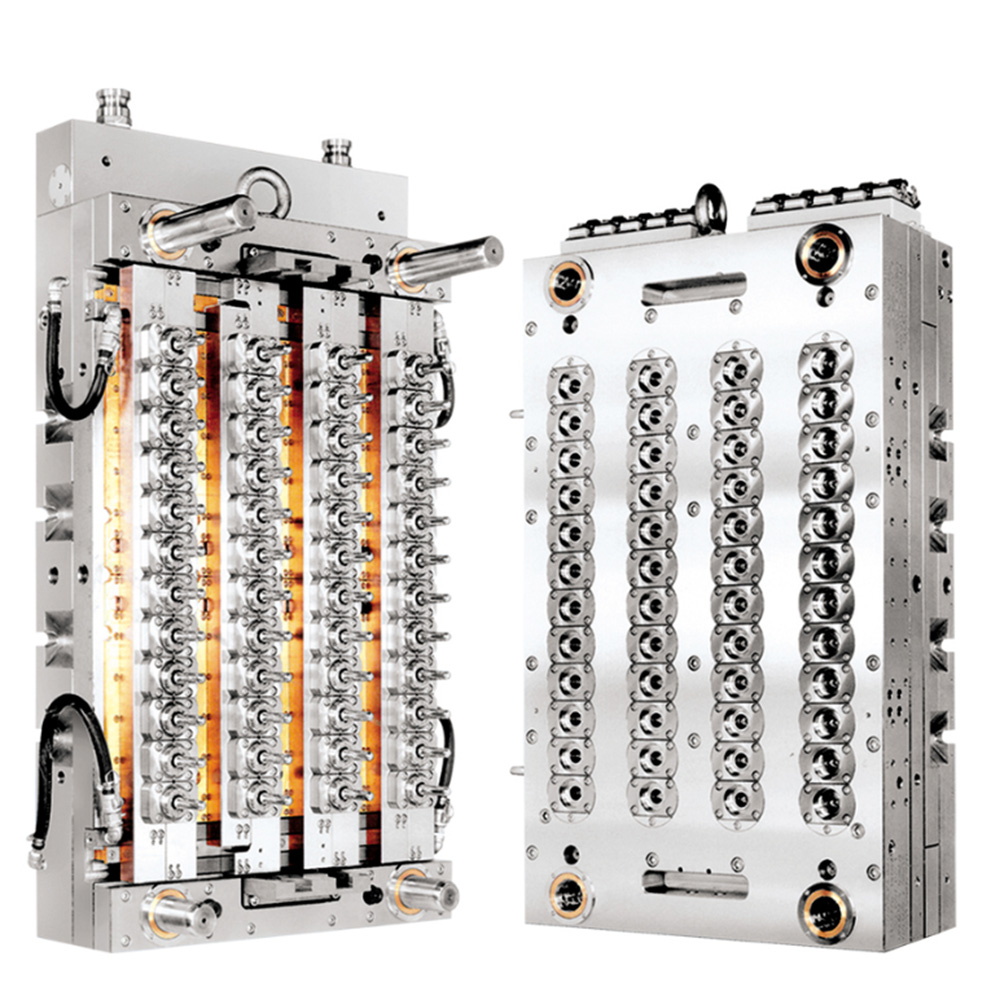
This article explains the key factors that determine preform mold life and how Meto designs, builds, and supports molds that consistently achieve 5+ million cycles.
Part 1: Three Factors That Kill Preform Molds Early
Almost every premature mold failure traces back to one of three root causes.
Factor 1: Wrong Steel or Poor Heat Treatment
The steel in a preform mold cavity must be hard enough to resist wear but tough enough not to crack. Many low-cost molds use P20 steel (1.2311), which is soft and wears quickly. Others use the right steel but poor heat treatment — single temper instead of double, atmosphere furnace instead of vacuum — resulting in brittle or soft cavities.
The result: Neck finish wear, surface pitting, or cracking before 2 million cycles.
Factor 2: Uneven Cooling
Hot spots accelerate wear. When one area of a cavity runs significantly hotter than another, that area wears faster. Uneven cooling also causes dimensional variation, which leads to flash and other problems.
The result: Localized wear, thermal fatigue cracks, and inconsistent preform quality.
Factor 3: Poor Maintenance
Even the best mold will fail early without proper care. Neglected cooling channels scale up, reducing cooling efficiency. Unlubricated guide bushings wear out, causing misalignment. Uninspected gate areas develop wear that spreads.
The result: Gradually declining performance, then sudden failure.
Part 2: How Meto Addresses Each Factor
For Factor 1: Premium Steel + In-House Vacuum Heat Treatment
Meto does not compromise on material or heat treatment.
| Requirement | Meto Standard |
|---|---|
| Steel grade (standard high-volume) | 1.2343 (H11) — certified, mill traceable |
| Steel grade (extreme wear) | 1.2343 + plasma nitriding |
| Steel grade (corrosive / rPET) | 1.2083 (420 stainless) |
| Heat treatment | In-house vacuum furnace |
| Tempering | Double temper (two cycles) |
| Hardness | 48–52 HRC, verified on every cavity |
| Decarburization | Zero (vacuum process) |
Why this matters: 1.2343 with proper vacuum heat treatment and double tempering delivers 4–6 million cycles. Add nitriding, and you reach 6–8 million cycles. Cheap steel and poor heat treatment cannot come close.
For Factor 2: Conformal Cooling + Thermal Verification
Meto designs cooling systems that eliminate hot spots.
Meto cooling features:
Conformal cooling channels that follow the preform contour
CFD (Computational Fluid Dynamics) analysis before manufacturing
Individual cavity cooling circuits (not shared)
Thermal imaging verification — temperature variation ≤3°C
A mold with uniform cooling wears uniformly. Uniform wear means longer useful life.
For Factor 3: Maintenance-Friendly Design + Documentation
Meto designs molds to be maintained, not just used.
| Design Feature | Maintenance Benefit |
|---|---|
| Quick-change cavity inserts | Replace worn cavities without removing mold from machine |
| External cooling manifolds | Easy access for cleaning |
| Standardized wear parts | Off-the-shelf availability, lower cost |
| Cavity numbering | Easy identification of problem cavities |
Every Meto mold ships with a maintenance guide that includes:
Lubrication points and schedule
Cooling channel cleaning procedure
Torque specifications for all fasteners
Spare parts list with part numbers
Troubleshooting flowcharts
Part 3: Expected Life by Steel Grade and Application
| Steel Grade | Surface Treatment | Expected Life | Best For |
|---|---|---|---|
| 1.2311 (P20) | None | 1–2 million cycles | Prototypes, low volume |
| 1.2343 (H11) | None | 4–5 million cycles | Standard PET, medium-high volume |
| 1.2343 (H11) | Plasma nitriding | 6–8 million cycles | High volume, abrasive materials |
| 1.2083 (420 stainless) | None | 5–6 million cycles | rPET, PCR, corrosive materials |
| 1.2767 | Vacuum heat treat | 5–7 million cycles | Extreme wear, pinch-off applications |
For customers targeting 5+ million cycles, Meto recommends 1.2343 with vacuum heat treatment as the minimum. For 6+ million cycles, we recommend adding plasma nitriding.
Part 4: Real Customer Results
Case 1: 32-Cavity Water Preform Mold — 6.2 Million Cycles
| Detail | Information |
|---|---|
| Customer | National water brand, Southeast Asia |
| Steel | 1.2343 + plasma nitriding |
| Preform weight | 18g |
| Current life | 6.2 million cycles, still running |
| Maintenance | Bushings replaced at 2.5M and 5.0M; cooling cleaned every 500k |
Customer feedback: “We expected 4 million cycles. At 6.2 million, this mold is still producing good preforms.”
Case 2: 48-Cavity CSD Preform Mold — 4.8 Million Cycles
| Detail | Information |
|---|---|
| Customer | Soft drink bottler, South America |
| Steel | 1.2343 (no nitriding) |
| Preform weight | 24g |
| Current life | 4.8 million cycles, still running |
| Condition | Neck finish wear within tolerance |
Customer feedback: “Tracking toward 6 million cycles before first refurbishment.”
Case 3: 24-Cavity rPET Mold — 3.5 Million Cycles (No Corrosion)
| Detail | Information |
|---|---|
| Customer | European rPET bottle producer |
| Steel | 1.2083 (420 stainless) |
| Material | 50% rPET |
| Current life | 3.5 million cycles |
| Condition | No pitting, no corrosion |
Customer feedback: “Our previous carbon steel mold pitted at 1.8 million cycles. The Meto stainless mold has no pitting at 3.5 million.”
Part 5: The Maintenance Factor — What You Must Do
Meto builds molds for longevity, but maintenance is a shared responsibility.
Required Maintenance Schedule
| Frequency | Action |
|---|---|
| Daily | Wipe cavities, check cooling flow |
| Weekly | Lubricate guide pillars and ejector plate |
| Monthly | Inspect gate area, check ejector pins |
| Every 500k cycles | Clean cooling channels, replace O-rings |
| Every 1M cycles | Inspect guide bushings, check cavity surface |
| Every 2M cycles | Full inspection, preventive replacement of wear parts |
Signs That Maintenance Is Needed
| Symptom | Probable Cause |
|---|---|
| Flash on preforms | Worn guide bushings or misalignment |
| Preforms sticking | Surface wear or poor cooling |
| Inconsistent weight | Cooling variation or gate wear |
| Longer cycle time | Scaled cooling channels |
| Rough preform surface | Cavity pitting or scratching |
Common Maintenance Mistakes to Avoid
| Mistake | Consequence |
|---|---|
| Using wrong lubricant | Guide component failure |
| Ignoring cooling channel cleaning | Hot spots, accelerated wear |
| Overtightening fasteners | Cracked plates or stripped threads |
| Mixing cavity inserts between molds | Alignment problems |
| Delaying bushing replacement | Damaged guide pillars |
Meto‘s maintenance guide covers these mistakes and how to avoid them.
Part 6: Refurbishment — Extending Life Beyond 5 Million Cycles
Even the best mold will eventually need refurbishment. Meto offers refurbishment services for our molds and for molds from other manufacturers.
When to Refurbish
| Condition | Action | Typical Cost |
|---|---|---|
| Neck finish wear | Recut threads and sealing surface | 10–15% of new mold |
| Cavity surface dull | Repolish all cavities | 15–20% of new mold |
| Gate area wear | Recondition valve gate seat | 5–10% of new mold |
| Guide bushings worn | Replace all bushings | 3–5% of new mold |
| Full refurbishment | All of the above | 25–35% of new mold |
Expected Life After Refurbishment
| Refurbishment Type | Additional Life |
|---|---|
| Minor (bushings + gate) | 1–2 million cycles |
| Major (recut + repolish + bushings) | 2–3 million cycles |
Refurbishment is almost always more economical than replacement if the core mold structure (plates, manifolds, cavity bases) is sound.
Part 7: Cost Comparison — Short Life vs. Long Life
| Factor | Short-Life Mold (1.5M cycles) | Long-Life Meto Mold (5M+ cycles) |
|---|---|---|
| Initial mold cost | $24,000 | $38,000 |
| Cycles before replacement | 1.5M | 5.0M |
| Molds needed over 5 years (4M cycles/year) | 3.3 | 1.0 |
| Total mold cost over 5 years | $79,200 | $38,000 |
| Downtime for changeovers (3 days per mold) | 10 days | 3 days |
| Lost production value ($5,000/day) | $50,000 | $15,000 |
| Total 5-year cost | $129,200 | $53,000 |
5-year savings with Meto: $76,200 — plus fewer production interruptions.
Part 8: Meto‘s Commitment
When you buy a preform mold from Meto, you are not buying a commodity. You are buying:
Certified steel matched to your application
In-house vacuum heat treatment with double tempering
100% hardness verification on every cavity
Conformal cooling with thermal imaging validation
Maintenance-friendly design with quick-change features
Documentation including maintenance guide and spare parts list
Refurbishment support when the time comes
Our standard high-volume preform mold (1.2343, vacuum heat treated) is designed for 4–6 million cycles. With nitriding, we deliver 6–8 million cycles.
Conclusion: 5+ Million Cycles Is Not a Dream — It Is a Specification
Short preform mold life is not inevitable. It is the result of using the wrong steel, accepting poor heat treatment, neglecting cooling design, or failing to maintain.
Meto addresses every factor: premium steel, in-house vacuum heat treatment, conformal cooling, maintenance-friendly design, and ongoing support.
If you are ready to stop replacing molds every 1–2 million cycles, talk to Meto. We will help you achieve 5+ million cycles — and lower your cost per preform.

Ruby
We can provide you with high-quality PET preform molds,cap molds,and blow molding machines.Looking forward to communicating and cooperating with you!
Helpline and Support
008613757660057